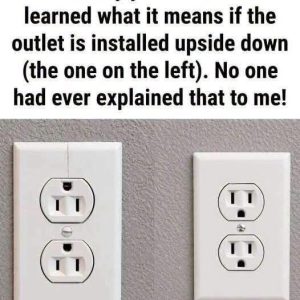
If you have ever noticed a wall outlet with the ground hole facing upward, you may have wondered whether it was installed incorrectly. While many outlets are positioned with the ground opening facing downward, an upside-down outlet can sometimes have a practical explanation. In older homes, this orientation was occasionally used as a visual clue that an outlet had special wiring or served a particular purpose.
Years ago, many homes relied on switched outlets instead of ceiling lights. An electrician could connect a wall switch to one half of an outlet, allowing someone to turn on a lamp without having to enter a dark room, while the other half remained powered for regular devices. In some cases, mounting the outlet upside down made it easier to recognize this type of setup without opening the wall or testing the wiring.
However, outlet orientation does not always reveal what is happening behind the wall. Modern electricians may install outlets upside down because of personal preference, company practices, local habits, or the design of the electrical installation. Some people also believe that an upside-down outlet could provide a small safety benefit because the grounding connection may make contact first if a plug becomes partially loose, although this is not a universal requirement.
So, the next time you see an outlet that appears to be upside down, there is no need to immediately assume it was installed incorrectly. The position of the outlet alone cannot confirm whether it has special wiring or serves a different purpose. It may simply reflect an electrician’s preference or an older installation practice. To determine what is actually happening behind the outlet, the wiring should be properly tested or inspected by a qualified professional.